APSCO Power
Industrial Manufacturer Website with Application-Driven Product Discovery


Project Overview
APSCO has been designing and manufacturing fluid power systems for the mobile equipment and transportation industries since 1964. With a catalog spanning pneumatic cylinders, hydraulic components, air controls, consoles, actuators, valves, and an expanding line of new technology products, the company needed a website that could communicate both legacy authority and forward-looking innovation at the same time.
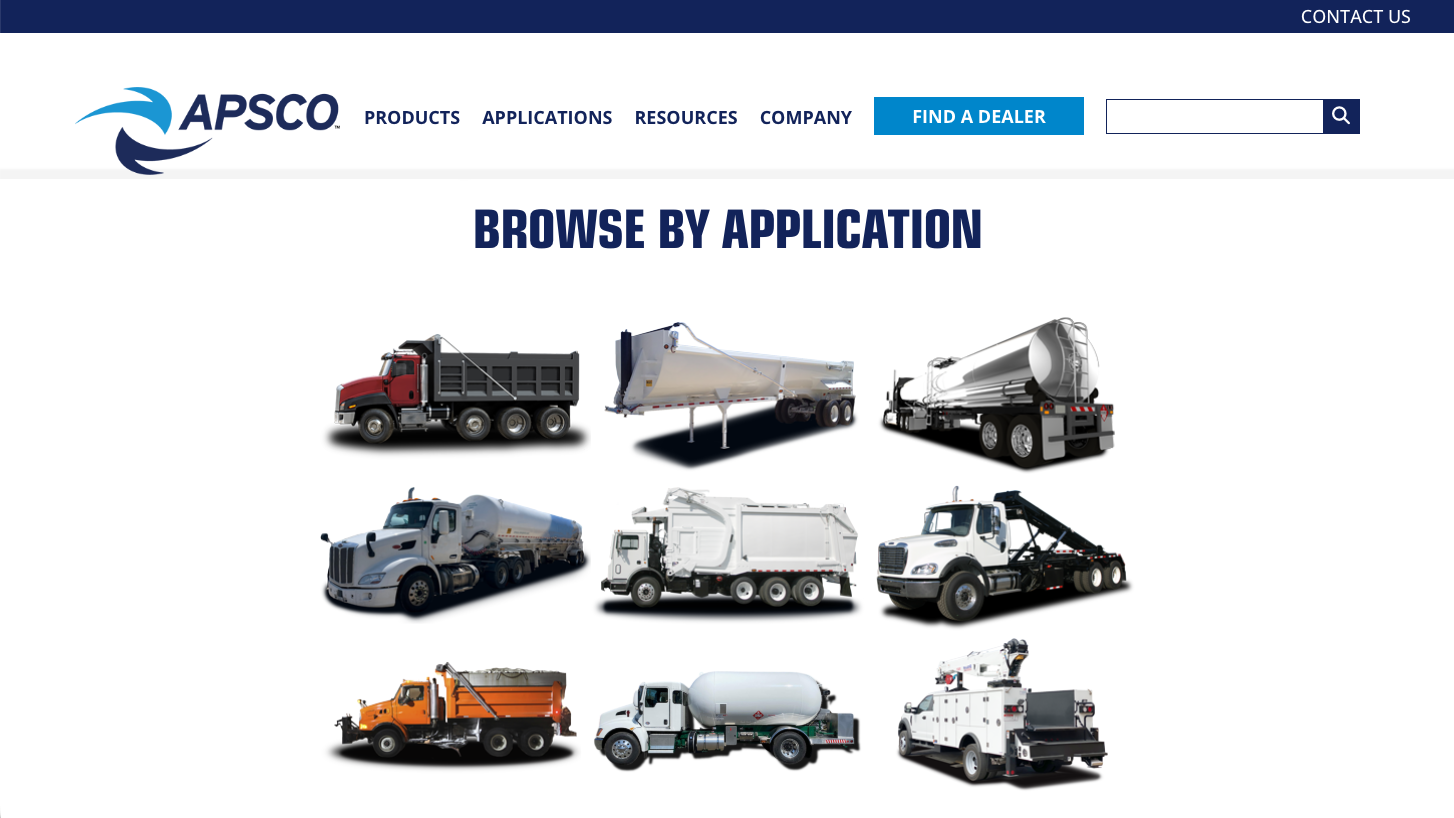
The challenge wasn’t just presenting products — it was helping the right buyers find the right products quickly. APSCO serves a technically sophisticated audience: truck body builders, fleet operators, OEM manufacturers, and distributors who need to match specific components to specific applications across a wide range of vocational truck types, from dump trucks and compactors to snow and ice spreaders, propane bobtails, winch trucks, and cryogenic tankers.
A flat, generic catalog approach would have buried that complexity rather than resolved it. The site needed to function as a genuine product discovery tool, organized around the way customers actually work — by application and by vehicle type — rather than by internal part number logic alone.
At the same time, the site had to support APSCO’s ongoing product expansion. The company was actively launching new technology products like the APEX control system and EDM electric actuator series, and the platform needed to accommodate new releases, press coverage integration, trade event promotion, dealer network tools, and careers content without requiring structural rebuilds each time.
Key Challenges & Solutions
Translating a Deep Technical Catalog Into an Intuitive Browsing Experience
APSCO’s product line is genuinely complex. Products exist at the intersection of multiple variables: application type, vehicle class, manufacturer compatibility, configuration options, and part number variants. For a buyer configuring a dump truck, the relevant products span consoles, actuators, air control valves, cylinders, and kits — each with detailed compatibility tables, dimensional specs, and installation documentation.
The information architecture was built around two parallel discovery paths: browse by application and browse by product type. Rather than forcing users into a single taxonomy, both paths lead to the same product destinations, accommodating buyers who know their truck application and buyers who know the product category they’re looking for. Product pages themselves were structured to surface the technical detail industrial buyers expect — spec tables, part number matrices, seal kit references, installation drawings — without overwhelming users who are still at the evaluation stage.
Supporting Dual Navigation Structures Without Creating Redundancy
The application-first and product-first navigation approaches had to coexist cleanly without creating a confusing or redundant browsing experience.
The solution was a shared content architecture where product pages served as the single source of truth, but were reachable through multiple filtered pathways. Application pages acted as curated entry points that organized relevant products under familiar job-site contexts — dump trucks, refuse, snow and ice, propane, and so on — while the product section organized the same inventory by component category. This let the site feel intuitive to different kinds of buyers without duplicating content or creating maintenance overhead.
Communicating Legacy Credibility Alongside New Product Innovation
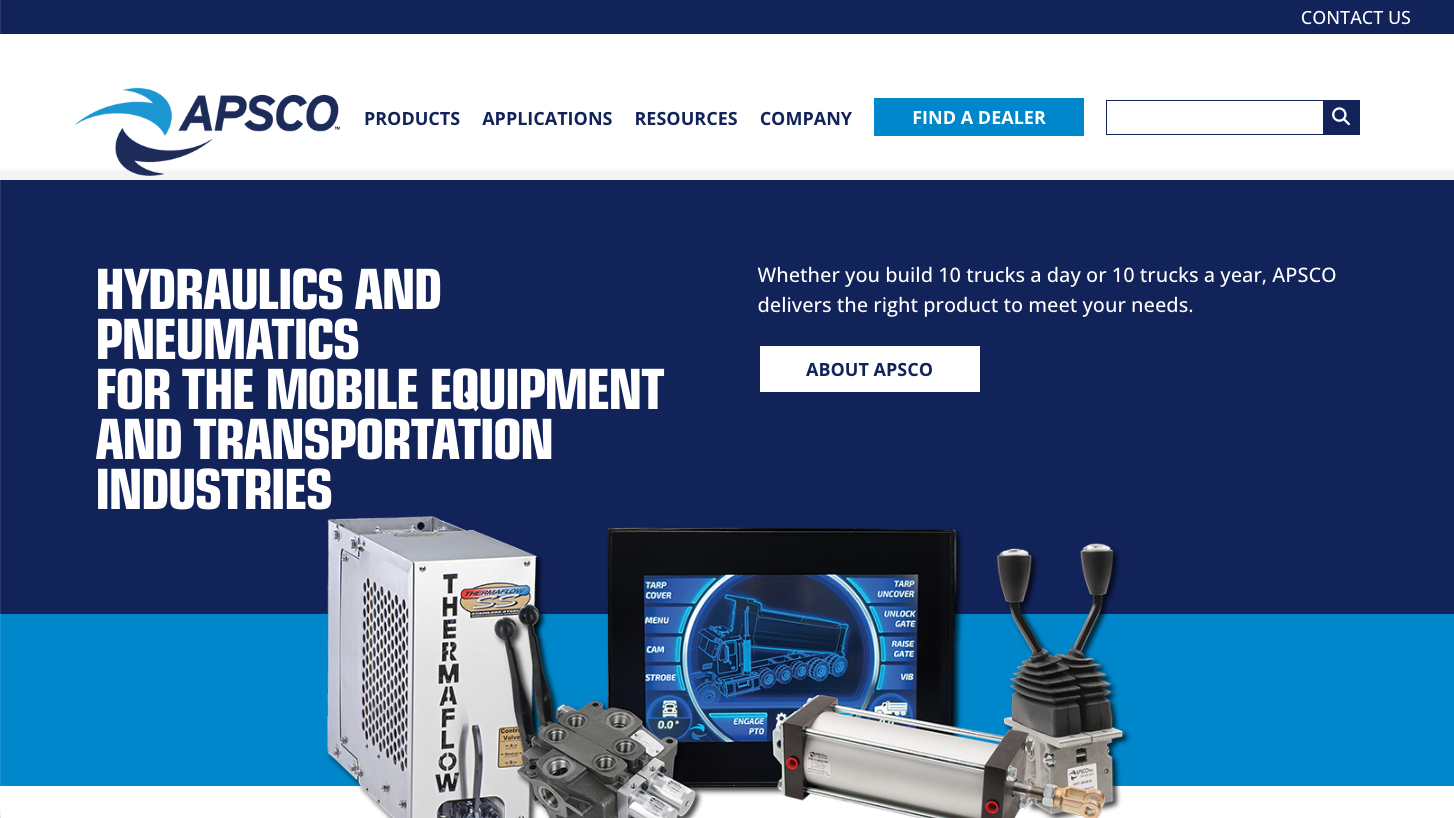
APSCO occupies an unusual position: a 60-year-old company that is actively pushing into new technology territory. The APEX display and control system, the EDM electric actuator series, and the ATAS trailing axle hydraulic manifold represent a meaningful shift in the company’s product direction, and that story needed to come through on the site.
The design and content strategy had to balance the credibility signals of a long-established manufacturer — ISO certification, proven product lines, North American dealer network — with the energy of a company entering a new product era. The “New” product section and the APEX feature placement on the homepage gave new releases prominent, dedicated visibility without disrupting the catalog structure that existing customers relied on.
Enabling Dealer Network Discoverability
APSCO distributes through a network of regional dealers and distributors rather than selling direct in all cases. For buyers at the point of purchase, the ability to find a nearby distributor is a critical conversion step that many industrial sites handle poorly.
A dedicated Dealer Locator tool was built directly into the primary navigation, giving it persistent, top-level visibility across the entire site rather than burying it in a contact or resources page.
The Work
Application-Oriented Site Architecture
A significant portion of the project focused on restructuring the site’s information architecture around how APSCO’s buyers actually make purchasing decisions.
The dual-path navigation system — applications and product type — was developed to serve both experienced buyers with a clear component in mind and newer buyers who approach the problem from the equipment they’re building or maintaining. Vocational truck categories became the organizing logic for application pages, making the site immediately legible to anyone working in the truck body manufacturing or fleet maintenance space.
Technical Product Page Development
Product pages were built to carry a high density of technical content without sacrificing usability. Spec tables, compatibility matrices, part number variants, configuration options, downloadable installation drawings, and seal kit cross-references were structured consistently across hundreds of individual product entries.
The consistency of this structure was as important as the content itself — buyers moving between product pages needed to be able to scan and compare quickly, and a coherent template system made that possible while also reducing the effort required to populate and maintain individual pages.
New Product Launch Infrastructure
The platform was built to accommodate APSCO’s active product development pipeline. The New Releases section provided a dedicated, crawlable destination for recently introduced products, and individual product pages like the APEX integrated press coverage links directly, extending the reach of earned media attention from outlets like Power & Motion, Fleet Equipment Magazine, and OEM Off-Highway.
CMS and Marketing Support Structure
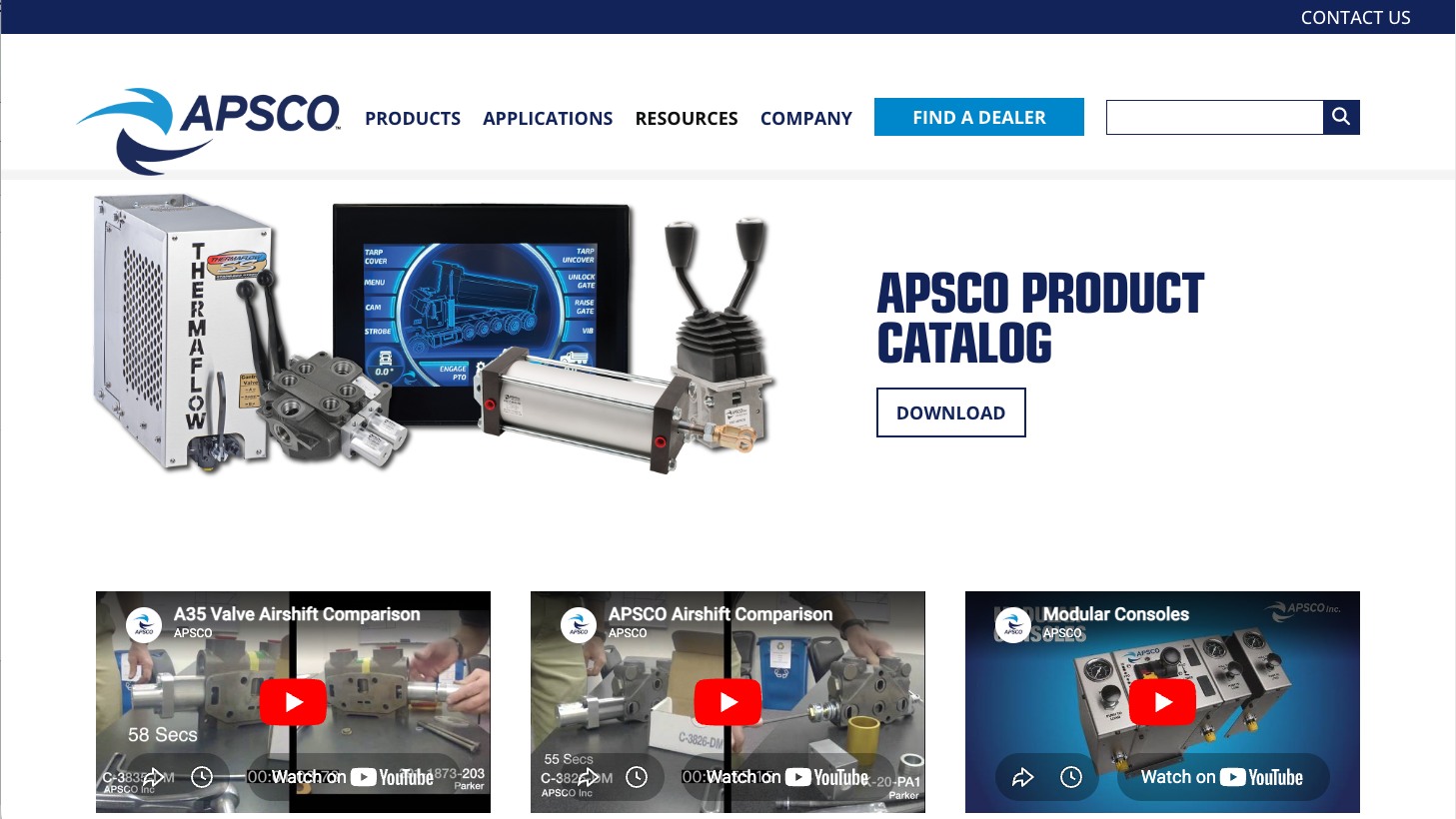
Beyond the product catalog, the site was built to support the full scope of APSCO’s ongoing marketing activities: trade event promotion through the News and Events section, recruiting through a Careers page, downloadable resources including the full product catalog PDF, and a structured contact and lead generation form for sales inquiries.
Feature Highlights
Dual-Path Product Discovery
The browse-by-application and browse-by-product-type navigation structure allows buyers with different mental models to reach the same products efficiently, reducing friction at the earliest stage of the buying process.
Technically Structured Product Pages
Each product page was built around a consistent content architecture that surfaces specs, part numbers, configuration options, compatibility references, and supporting documentation in a format that industrial buyers expect and can scan quickly.
New Product Visibility
A dedicated product launch section and homepage feature placement gave APSCO a scalable mechanism for introducing new technology products without disrupting the established catalog structure.
Integrated Dealer Locator
A prominently placed dealer locator tool gave buyers a clear, always-accessible path toward local distribution, supporting conversion at the bottom of the browsing funnel.
Scalable Content Infrastructure
The CMS architecture was designed to support ongoing catalog growth, new product releases, trade event content, and downloadable resources without requiring structural changes to the site.
Outcome
The final platform gave APSCO a digital presence that could serve the full complexity of their product line and customer base without overwhelming either one.
By organizing the site around application context rather than internal catalog logic, the browsing experience became significantly more useful to the truck builders, fleet operators, and distributors who rely on APSCO products. Technical depth was preserved where buyers needed it, while cleaner navigation pathways reduced the friction of getting there.
At the same time, the platform positioned APSCO well for the next chapter of the company — one defined by new technology products, an expanding dealer network, and a product pipeline that needed a site infrastructure capable of keeping pace.
The result was a site that honored sixty years of manufacturing credibility while giving APSCO the tools to grow into the next sixty.