The Tapestry Registry
National Resource Discovery & Impact Platform
Project Overview
The Association for Enterprise Opportunity needed a digital platform capable of doing something genuinely difficult: turning a sprawling national network of Black business support organizations into something discoverable, navigable, and actionable for the people who needed it most.
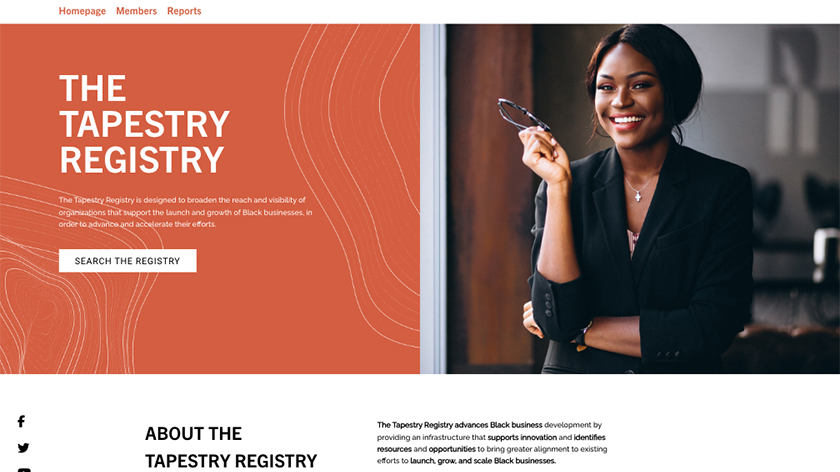
The Tapestry Registry wasn’t just a directory. It was the public-facing infrastructure for an initiative designed to advance Black business ownership across the country by connecting entrepreneurs to the right organizations, resources, and capital — wherever they were. The platform needed to surface hundreds of vetted member organizations in a way that felt useful and immediate rather than overwhelming, while simultaneously communicating the scale and credibility of the effort itself.
At the same time, the site had to serve multiple audiences at once: entrepreneurs looking for local support providers, policymakers and researchers engaging with data and reports, and ecosystem partners who needed to understand the collective impact of the network. Serving all three without losing clarity for any one of them became the defining design and architecture challenge of the project.
Key Challenges & Solutions
Building a Directory That Feels Like a Tool, Not a List
The member database spans hundreds of verified organizations across dozens of states, serving different communities, business stages, and service categories. A conventional alphabetical or map-based directory would have buried the most relevant results for any given user under layers of irrelevant ones.
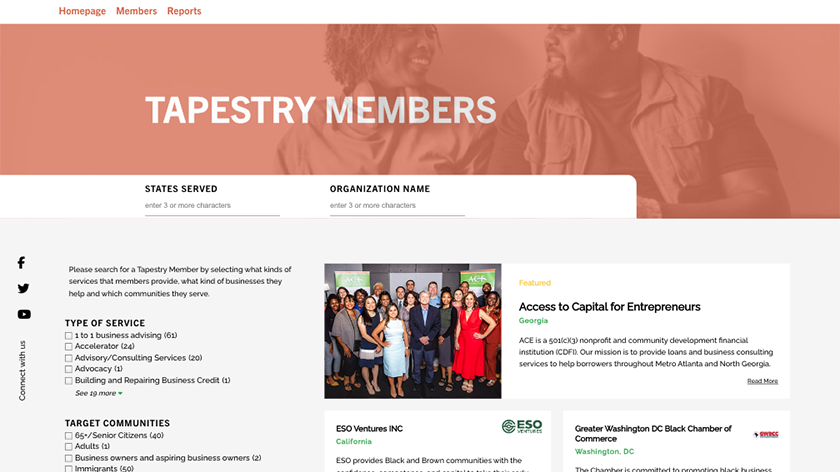
The filtering and search architecture was built around the actual decision-making process of an entrepreneur looking for help — allowing visitors to narrow by type of service, target community, industry served, and business stage simultaneously. The goal was for a first-generation restaurant owner in Georgia and a returning-citizen tech entrepreneur in Michigan to each arrive at a short, relevant list of providers without friction.
Communicating Impact at Scale Without Losing Human Context
The collective impact numbers behind the Tapestry Registry are significant: tens of thousands of individuals served, hundreds of millions of dollars in loans dispersed, thousands of grants awarded, and training programs offered across the country. Presenting that data in a way that felt credible and legible — rather than like a statistics dump — required deliberate information design.
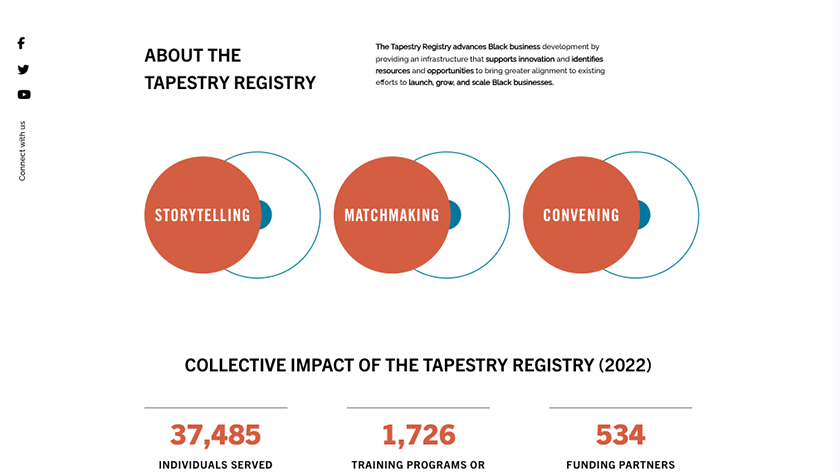
Rather than burying the metrics in a report or footnoting them on a static page, the impact data was structured as an interactive system, allowing visitors to explore categories like access to capital, market access, pipeline development, and barrier removal in context. This turned abstract aggregate numbers into a more navigable picture of what the network actually does.
Connecting a Knowledge Library to a Live Network
The platform also needed to function as a research and editorial resource. The reports library encompasses decades of scholarship on Black entrepreneurship, the racial wealth gap, access to capital, and economic mobility — material that gives the Tapestry Registry its intellectual grounding and policy credibility.
Rather than treating the reports section as a separate archive, the architecture was designed to let that body of knowledge coexist with the live directory and impact data as part of a coherent platform story — positioning AEO not just as a connector of resources, but as a serious research and advocacy organization in the space.
The Work
Searchable Member Registry with Layered Filtering
The core of the platform is a fully searchable, filterable directory of vetted support organizations. The filtering system was developed to reflect the real-world criteria an entrepreneur would use when looking for help — type of service, communities served, industries, and business stage — rather than administrative categories that would only make sense to someone already familiar with the ecosystem.
Hundreds of member profiles were structured and organized to ensure consistency in presentation while allowing enough flexibility for individual organizations to communicate their distinct focus areas and geographic reach.
Interactive Impact Dashboard
The 2022 collective impact data was built out as an interactive visualization system rather than a static reporting page. Visitors can explore impact metrics across four programmatic categories, moving from high-level aggregate numbers into the specific types of work the network performs. The approach kept large numerical datasets from feeling inert while reinforcing the credibility and reach of the registry.
Research Library and Editorial Infrastructure
The reports section was built to support a growing archive of third-party research, AEO-commissioned studies, and curated resources relevant to the Black business ecosystem. The infrastructure allows the platform to continue functioning as a knowledge resource over time, with new publications added without disrupting the broader site structure.
Audience-Differentiated Navigation and Storytelling
The homepage and overall site architecture were designed to speak to multiple audiences — entrepreneurs, researchers, funders, and policy stakeholders — without forcing any of them through an irrelevant experience to get where they needed to go. Storytelling, impact data, and registry access were sequenced to orient all audiences quickly before directing them toward the part of the platform most relevant to their needs.
Feature Highlights
Multi-Criteria Member Search
A filtering system built around real user intent, allowing visitors to find relevant local providers by service type, community focus, industry, and business stage.
Collective Impact Visualization
An interactive data experience that communicates the scale and scope of the Tapestry network across access to capital, market access, pipeline, and barrier-removal categories.
Verified Member Profiles
Hundreds of thoroughly vetted organizational profiles, structured for consistency and geographic coverage across the national network.
Research Library Infrastructure
A scalable editorial architecture supporting a growing library of reports, studies, and resources on Black entrepreneurship and economic equity.
Outcome
The finished platform gave the Tapestry Registry a digital presence capable of matching the ambition and complexity of the initiative itself.
What could have become an unwieldy institutional directory instead became a genuinely useful tool — one that an entrepreneur in any part of the country could use to find verified, relevant support in a matter of minutes, while also communicating to funders, researchers, and policy partners the full weight of what the network had already accomplished.
More broadly, the project established a platform infrastructure that could continue to grow as the registry expanded, new impact data was collected, and new research entered the library — without requiring the architecture to be rebuilt from the ground up each time the initiative evolved.