Gemini Agency
Marketing, Editorial & Lead Generation Platform

Project Overview
Gemini Agency needed a website capable of presenting a large and evolving digital marketing practice without overwhelming visitors or fragmenting the user experience.
The agency offers a broad range of services spanning paid media, SEO, social media, AI & automation, creative services, web development, and email marketing across multiple industries and client types. The challenge was not simply organizing pages — it was creating a scalable marketing platform capable of functioning simultaneously as a service showcase, editorial publishing system, case study portfolio, recruitment tool, and lead-generation engine.
The project required balancing several competing goals at once: helping prospective clients navigate a wide service catalog, supporting multiple forms of thought leadership content, integrating conversion pathways throughout the experience, and maintaining a bold, high-energy visual presentation that reflected the agency’s brand personality.
Rather than approaching the site as a collection of independent sections, the platform was structured as a connected marketing ecosystem designed to support long-term growth, content expansion, and ongoing campaign evolution.
Key Challenges & Solutions
Organizing a Large Service Ecosystem
Gemini’s service offerings spanned multiple major categories, each with its own sub-services, strategic positioning, and supporting content.
A traditional flat navigation structure would have made the platform difficult to explore, particularly for users arriving with different levels of marketing knowledge or different service needs. The information architecture focused heavily on parent-child relationships, service hubs, contextual pathways, and layered navigation systems designed to make the agency’s capabilities feel expansive without becoming confusing.
The resulting structure allowed visitors to move naturally between broad service categories, detailed sub-service pages, related case studies, and supporting editorial content.
Supporting Multiple Content & Publishing Systems
The platform needed to support two distinct forms of content publishing: editorial thought leadership and results-focused client case studies.
Rather than combining these into a single generalized blog structure, each content ecosystem was developed independently with its own organizational logic, filtering systems, and presentation style. This allowed the agency to maintain clearer separation between educational content and portfolio storytelling while still preserving cohesion across the broader site experience.
The publishing architecture also supported dynamic relationships between services, industries, case studies, and insights content, helping surface more contextually relevant material throughout the site.
Building Conversion Pathways Throughout the Experience
Lead generation was integrated across nearly every section of the platform.
The project included multiple conversion systems ranging from service inquiry forms and newsletter subscriptions to campaign-specific landing pages, gated engagement pathways, and chatbot-driven interaction points. Rather than isolating conversion into a single contact page, the platform was designed to create continuous opportunities for engagement throughout the browsing experience.
This required maintaining consistency across multiple form systems, integrations, and user flows without disrupting the overall visual identity of the platform.
Creating a Dynamic Front-End Experience Without Excessive Bloat
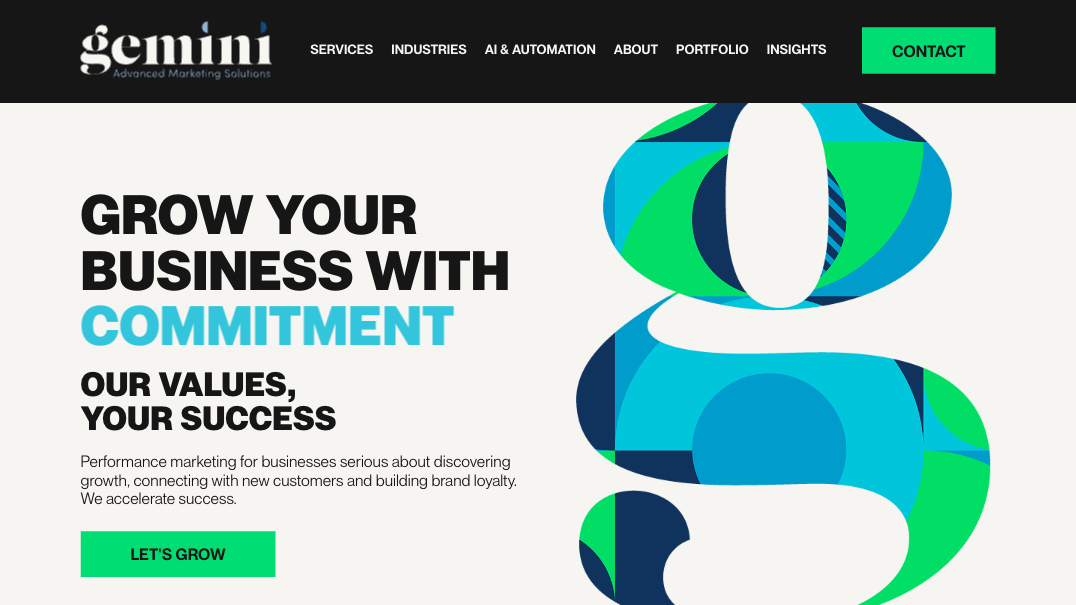
The visual direction relied heavily on animation, motion, rotating content systems, and interactive front-end elements designed to create a more energetic and modern agency presentation.
Rather than relying heavily on rigid third-party page builders or oversized animation frameworks, the implementation emphasized lighter-weight custom solutions tailored specifically to the design system. Interactive hero messaging, rotating testimonial systems, AJAX-driven portfolio interactions, dynamic team carousels, and animated content behaviors were all integrated into a more performance-conscious front-end architecture.
The Work
Editorial & Marketing Architecture
A large portion of the project focused on building relationships between services, industries, insights content, case studies, testimonials, and conversion pathways.
Instead of creating isolated page templates, the site architecture emphasized dynamic content relationships that allowed different areas of the platform to reinforce one another contextually. This created stronger discovery pathways while also simplifying long-term content management behind the scenes.
Conversion-Focused UX Development
The user experience was designed heavily around progression and engagement.
Service pages, case studies, landing pages, editorial content, and navigation systems were all structured to help users move naturally between educational content, service exploration, trust-building elements, and conversion opportunities without feeling forced into a rigid funnel.
Special attention was given to balancing informational depth with usability so the platform could support both highly informed marketing buyers and visitors earlier in the research process.
Dynamic Content Systems
The platform relied heavily on reusable content systems and dynamic publishing relationships.
Case studies, insights articles, testimonials, team members, industries, and services were all structured to support ongoing expansion without requiring structural redevelopment as the agency continued growing. This allowed internal teams to manage large amounts of content efficiently while preserving consistency throughout the experience.
Custom Front-End Implementation
The front-end implementation focused on creating a more visually active and engaging browsing experience while maintaining responsive performance.
Animated hero messaging, interactive filtering systems, rotating content modules, AJAX-powered portfolio interactions, layered motion behaviors, and custom mobile navigation systems were all implemented as part of a broader effort to create a platform that felt modern, dynamic, and highly tailored to the agency’s brand identity.
Feature Highlights
Multi-System Editorial Publishing
Independent publishing systems supported both educational thought leadership and results-driven case study storytelling.
Conversion-Integrated User Experience
Lead-generation pathways were embedded throughout the platform rather than isolated to a single contact flow.
Dynamic Service & Industry Relationships
Services, industries, insights content, and portfolio work were connected contextually to improve discoverability and scalability.
Outcome
The finished platform gave Gemini Agency a significantly more scalable and strategically organized digital presence.
The agency gained a system capable of supporting long-term editorial publishing, portfolio expansion, service growth, recruitment initiatives, and ongoing lead-generation campaigns without sacrificing usability or brand cohesion.
More importantly, the project transformed the website from a conventional agency brochure into a more sophisticated marketing ecosystem — one designed to support business development, content strategy, and ongoing operational growth through interconnected publishing systems, dynamic content relationships, and conversion-focused user experience design.